
Aware. Anxious. Untreated.
an essay on the 1.17 billion(!) of us and the medicines we've stopped trusting

Mental Health Awareness Month is extremely personal to me.
May is a month when I think really hard about the people I love who have lived through major mental health issues — and the ones who didn’t make it through. I often think about the version of someone I knew before something shifted, and the version after, and the years in pain that I watched or felt. I am hopeful because I’ve seen people “come back” but I am also frustrated by how many people never make it back to their full, thriving selves.
I’m guessing mental health is personal to you, too. To almost every single person reading this. A sibling, a parent, a partner, a friend who stopped returning texts for a while, a teenage version of yourself you’d protect now if you could. We don’t always say it out loud. We make a kind of unspoken agreement, at most dinner tables, in most social situations not to. But it’s there — a quiet us, wide enough to include almost everyone, hidden enough that each of us still walks around feeling like the only one.

You want to know just how many are in the quiet us?
This week, The Lancet gave that quiet us a number. The Global Burden of Disease 2023 report — 204 countries, three decades of data, a research team you could fill a small concert hall with (seriously nearly 1200 people listed as contributors to this paper!) — found that 1.17 billion people are living with a mental health disorder. That number has nearly doubled since 1990. And before anyone reaches for the "well, there are just more people" — even after adjusting for population growth, the rate is up 24%.
In 1990, mental illness was the 12th-leading cause of disability-adjusted life-years globally. In 2023 it is the 5th. It has climbed seven rungs past things like road injuries and tuberculosis. It is now the single leading cause of years lived with disability on Earth, full stop — more than diabetes, more than back pain, more than any cause of suffering we don't get to die from. READ THAT AGAIN… Mental illness now the single leading cause of years lived with disability on Earth, full stop.
Some context and texure on Mental Illness from the Lancet
Within mental illness, the leading symptom — by a meaningful margin, in nearly every region of the world — is now ANXIETY. Anxiety disorders are the single largest contributor to global mental-health burden, with major depression a half-step behind and schizophrenia third. The Lancet team broke this down by region, and the picture is striking: anxiety leads the Americas, Western Europe, Australasia, the Middle East, and Sub-Saharan Africa. Major depression only edges ahead in much of East and South Asia and parts of Eastern Europe.
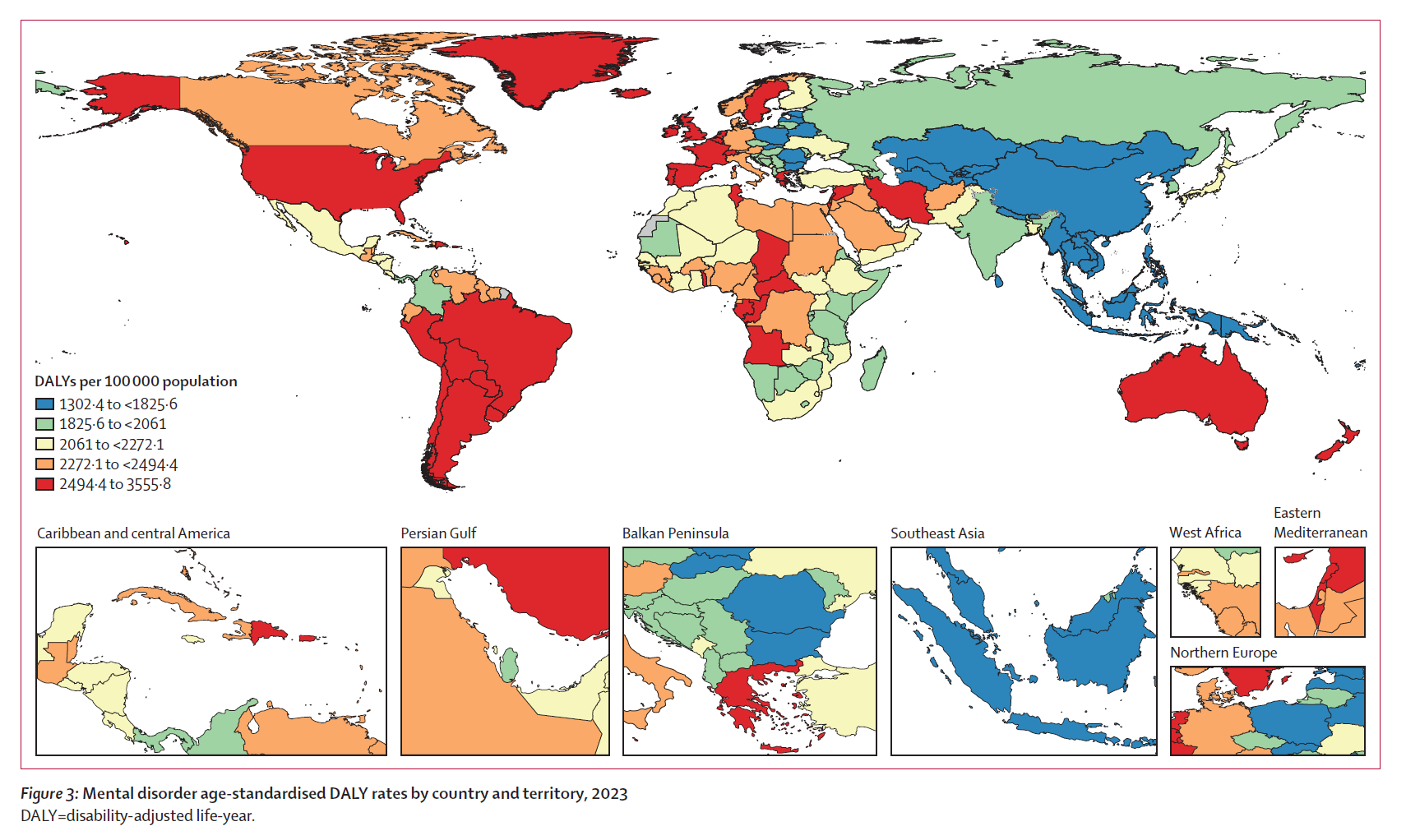
And it falls hardest on the young. The peak burden lands in the 15-to-19 age group. The kids you know who can't get out of bed, who quit the team without explaining, who scrolled themselves into a kind of grief they don't have words for — that demographic carries the heaviest share of this. Women carry more than men, in every region, at every age. It makes me so sad to think about each individual suffering and also the aggregate pain of what these maps represent.
Here is the part that really frustrates me.
A companion paper from the same research group found that in 90 countries, fewer than 5% of people with major depression receive what the WHO calls “minimally adequate” treatment. Not great treatment. Minimal. We have known this for years. We have a global action plan, signed in 2013, that committed countries to doubling mental health coverage by 2030. We are four years out. In many places, coverage hasn’t moved or has been reduced.
So what exactly have we been doing every May? Does this mental health awareness month even matter?
We have run, with somewhat extraordinary efficiency, a generation-long campaign to make sure people understand they are suffering. At least in the US, we have given the suffering a vocabulary. We’ve made it sayable more sayable and although there is still plenty of stigma and avoidance, the progress on awareness is real.
But awareness is not treatment.
Awareness is a key peice of the diagnostic step — flawed as that might be (see my essay on the DSM). The numbers in The Lancet are what happens when a society gets very good at the diagnostic step and very bad at everything that should come next. Naming a bone fracture is not setting a fracture with a cast. Knowing what depression is, is not the same as having a clinician who can see you this month for less money than your rent.
And there’s another piece of this that frustrates me, and it lives inside the culture rather than inside the policy.
We are in the middle of a soft revolt against “chemicals.” You can hear it in wellness podcasts and supplement ads, in TikTok monologues about “natural” healing, in the way bright, well-meaning people lower their voice a half-step when they mention being on an SSRI, as if confessing in a Catholic church. In my last Aether in Mind conversation, Jerry Rosenbaum — one of the early psychopharmacologists, someone who helped build the modern field from the inside — told me he was looked down on for that work even by colleagues, early on. Decades later, the stigma has shape-shifted. It dresses now in wellness language and “do your own research” language, but underneath it is the same instinct: medication is something to be transcended, “rooted out,” ideally avoided. This MAHA madness is so frustating (even if it’s well-intentioned, it is so short-sighted.)
I want to say this carefully, because the nuance matters.
Not everyone in distress needs a chemical. Some people genuinely don’t. Some need a therapist, a community, a different job, a different relationship to their phone, a different country to live in. Many of the deepest changes in a person’s mental life happen in places no prescription can reach.
But.
In many, many cases — more than the current mood is willing to admit — these drugs save lives. They alter trajectories. They get someone out of bed in week three, which lets them keep the job, which lets them keep the apartment, which lets them keep the version of themselves capable of doing the therapy, the relationships, the slower, harder work. I have watched this happen up close, more than once, in my own family and among friends. I have also watched it fail — watched the side effects bite, watched someone cycle through five medications before something finally landed, and sometimes nothing did. The drugs are not perfect. They need a generation of innovation. I am working on some of that. So are a lot of other people. It cannot come fast enough.
But the chemicals are not the enemy! They are not the lazy choice or the corporate choice or the unspiritual choice. They are a tool — one tool, in a kit that has to also include CBT, community, economic security, and a society less designed to break us. We need all of it. Telling people to choose between the chemical and the change is a category error, and right now it is an error that costs lives.
There’s an uncomfortable possibility inside this Lancet data. Some of the rise is almost certainly because more people now recognize what’s happening to them and say so out loud. That is what awareness working looks like. But some of it is real — pandemic, screens, isolation, economic vertigo, climate dread, political uncertainty, wars everywhere… take your pick — and we cannot cleanly separate the two. What we can tell is that the suffering is bigger than the infrastructure, and the gap is widening.
The awareness industry, in some quiet way, runs on the very burden it claims to address. The worse it gets, the more green ribbons get sold in May.
I honestly don’t know what to do with this except say it out loud, on the last weekend of the mental health awareness month, while the campaign is still in the air. So here is what I’d offer, in place of a green ribbon:
Call one specific person you’ve been worried about. Not “thinking of you.” Name the thing you noticed (the cancelled plans, the flatness in their voice, the weight, the drinking) and ask if it’s still happening. Today.
Talk about medication out loud. The soft revolt against chemicals runs on silence. If you take a psychiatric medication and you’ve been quiet about it and it is helping, say so to one person who didn’t know — one sentence, no caveats. I’m on X and it has helped me. If you don’t take one, ask someone who does what it’s been like, and listen without flinching. The stigma dies one conversation at a time. (Totally talk about what drug(s) haven’t worked too! Just normalize the discussion.)
Donate to a group actually doing the work. Crisis Text Line, The Jed Foundation, and The Trevor Project all hold 4-of-4 stars on Charity Navigator. About $25 funds one trained-counselor conversation with a young person in crisis.
What would it take, in your life or your community, to spend May 2027 not raising awareness — but closing a gap?
Aether in Mind is a newsletter about minds, medicine, and the spaces in between. If this hit something, share it with one person who needs to read it. That’s how we move.